November 1, 2017

Mums are in Season


The winter is approaching and you may have started planning a trip to go see the colored autumn leaves.  It is also the best season to enjoy the chrysanthemum in full bloom.  

As you may have noticed, the family crest of the Imperial family is the chrysanthemum.  It is the symbolic flower of Japan along with the cherry blossom.  Originally, chrysanthemum was imported from China for medicinal purposes.  The Japanese people enjoyed the beautiful flowers, and they began growing chrysanthemum for ornamental purposes.  According to the book published in the 17th century, there were already over 200 kinds of chrysanthemums grown in Japan.  Today, we have much wider variety of chrysanthemums in sizes, shapes and colors.  


In Japan, chrysanthemum has been traditionally recognized as the flowers offered to Buddha and the deceased.  It is often placed on the Buddhist altar and the graves.  Chrysanthemum was used for such offering because its scent was believed to remove evil spirits and the flowers were long-lasting.  The bouquets of chrysanthemums are always available at any flower shops and even supermarkets, and they are usually inexpensive.  Although other kinds of flowers are used as offerings today, I advise you to give it a second thought to give a bouquet of chrysanthemums to your girlfriend or your sick friend in order to avoid any confusion and misunderstanding.  


From October to November, many chrysanthemum festivals are held all over Japan and we enjoy the competitive exhibitions of the beautiful chrysanthemums as well as the figures and dolls made of chrysanthemums.  In Koto city, Chrysanthemum Festival is held at Kameido Tenjin Shrine from October 22 to November 23 this year.  I would recommend you to visit there because this is the only place you can see the chrysanthemum figure of Tokyo Skytree.  At Kameido Tenjin Shrine, the chrysanthemums will be in full bloom around mid-November.  

Would you like to know more about the Japanese culture?  Please join our tour.  https://kev.jp/
(by Kumiko)


October 1, 2017

Unique history of Koto area, depicted in traditional woodblock prints

Autumn is one of the best seasons to do something in Japan since it’s neither too hot nor too cold. So it is also the best season for us to go on one day trip!

During samurai period, about 300 years ago, our area Koto-Ward was one of the most popular destinations for people living in Edo, today’s Tokyo. So many places were depicted at the Ukiyoe, wood block prints. We are able to see the fine works and imagine atmospheres of those days through Ukiyoe.

Edo city began to develop as the central city of Japan about 400 years ago. Since then the population increased rapidly and the city expanded more and more. Through the development of Edo, our area was reclaimed from Edo Ocean and grew as the distribution center of Edo.

So lots of common people moved to this area, began to do business and this area became thriving well. This area became like gold rush in Edo. So this area grew the unique atmospheres and temperatures. They maybe one of the sources of something called Edo people temperatures. At the same time, it became cool and fashionable spots in Edo. So this area was very popular destination for people and depicted as the cool spots in Edo.      

Today, Tokyo didn’t remain those Edo atmospheres and temperatures. But our area still remains those a little. So it must be fun to take a walk around famous spots in those days, watching those Ukiyoe and feeling those Edo people temperatures.

(by Koichi)

September 1, 2017

Disaster Prevention Day

September 1st is “Disaster Prevention Day” in Japan. This day commemorates the Great Kanto earthquake that occurred on that day in 1923. There were many victims of fire partly because it occurred just before noon.

On the disaster prevention day, the extensive drills that assume mainly earthquake and fire are held in many schools from kindergarten to high school, local governments or community, public transport, etc. It is to learn procedures and routes of evacuation.

Many office buildings and commercial facilities also regularly conduct emergency drills, in order to prepare for unexpected catastrophes and to keep improving their emergency restoration measures.

In addition, during the period from August to October Japan is frequently hit by typhoon. These several years, natural disasters including torrential rain, floods are increasing. The importance of preparation against disasters is growing more and more.

Providing is preventing. If you are prepared, you do not have to worry. Koto-city has a facility that you can experience and learn earthquakes, named “Sona Area.” If you have time, why don’t you go and experience there?


For more information:


   The Tokyo Rinkai Park, in Koto-city, is a great disaster prevention facility with an experience center and a learning center. Once a big disaster occurs Tokyo and the suburb region, this is supposed to become one of emergency restoration activity centers.

(by Junko)

August 19, 2017

Fukagawa Hachimangu Shrine Festival


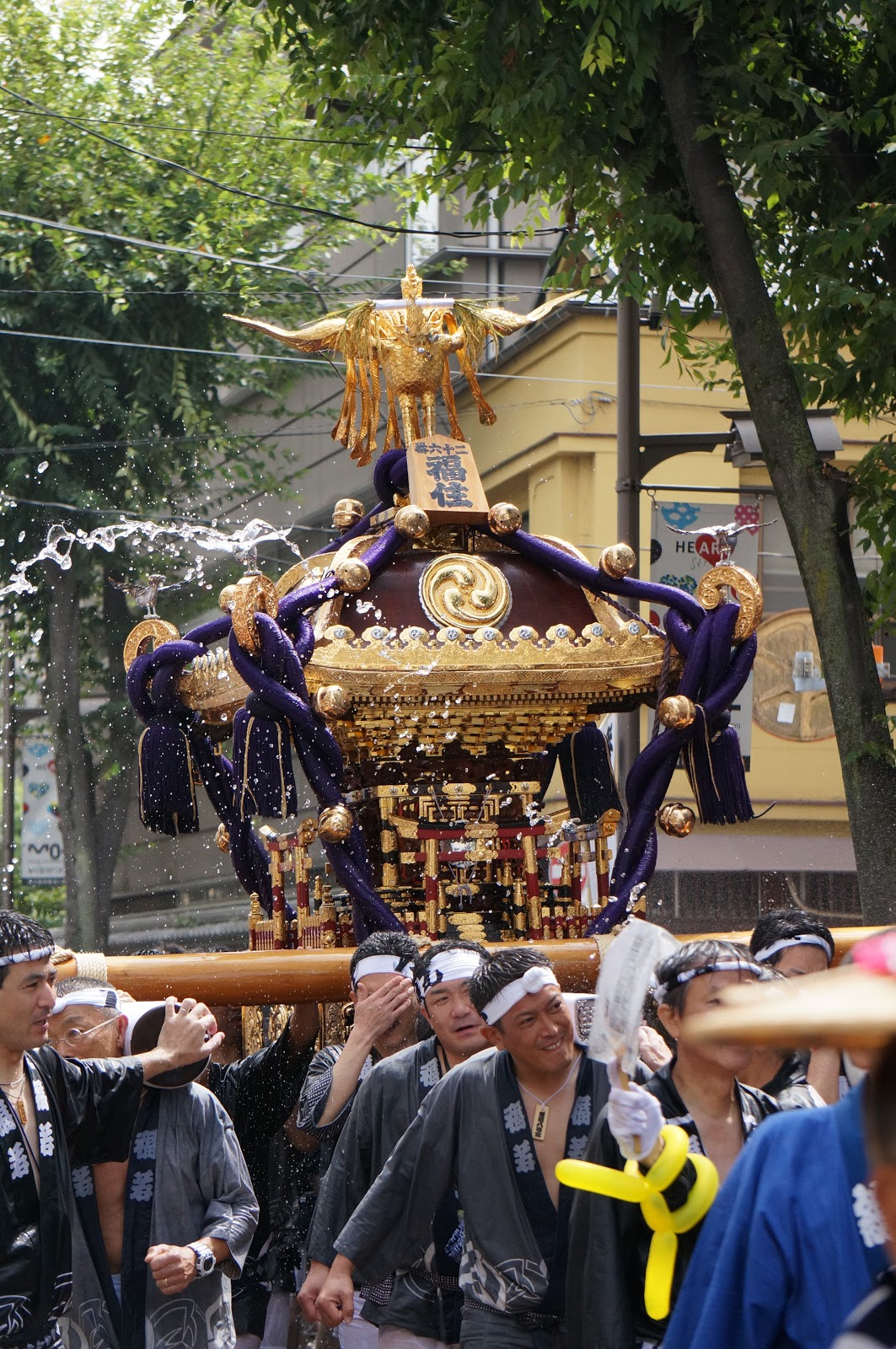
Getting soaked to the skin, happi-clad men and women in unison carried omikoshi or portable shrines through the streets in a major summertime festival in Tokyo recently, turning their procession route into a spiritual energy site.

The festival, commonly known as the Fukagawa Hachimangu Shrine Matsuri in the capital’s eastern city of Koto, is one of the three grand feasts in Japan’s metropolis. It is also called a “water-pouring festival,” in which onlookers pour buckets of water over omikoshi and its bearers to purify them. Some children use a toy water-cannon while local firefighters sprayed water with hoses at fixed spots along the route.

On the festival day, the god is believed to move to omikoshi temporarily from the main shrine. Fifty-three portable shrines shouldered by turns  paraded over a distance of an 8-kilometer (4.4 mile) route under the scorching sun.


The festival dates back to 1642, when son and heir to the third shogun Tokugawa Iemitsu was born. The feudalistic Edo period under the reigns of Tokugawa lasted from 1603 to 1867, when Japan took a course toward modernization. The shogun’s capital was called Edo, then.

By the early 18th century, Edo had a population of more than 1 million, making it the largest city in the world, surpassing London’s and Beijing’s. The Tomioka Hachimangu Shrine in an area popularly called Fukagawa is  about 3.5 kilometers (2 miles) east of the Imperial Palace ground.

The shrine was the venue for the promotional sumo tournament held for the first time to raise funds to repair shrines or temples during the Edo era. There are stone monuments of yokozuna or grand champion, ozeki or champion, and more to see in shrine precincts. It’s worth a visit.  Sumo is a national sport of Japan.

About 350,000 people were out in Sunday’s major festival, held once in every three years, according to the shrine and police accounts.

Japanese shrines are regarded as a sacred site where people often visit to pray for the safety of their families and the prosperity of business as well as whatever proper for them like success in the entrance examination.

(by Kozo)

August 6, 2017

The Festival Eve tour -- to fully enjoy once-in-three-years grand parade


It's the festival season. And the once-in-three-years big mikoshi parade is coming to Koto-ku, Tokyo!

More than fifty beautifully decorated mikoshi, or portable shrines, will parade through the town on August 13th, Sunday, with big splash of water thrown on them from water trucks and fire hoses.

To help fully enjoy the festival, we will have a special walking tour the day before, on August 12th.

The day before the parade, mikoshi
visit the shrine for purification
With the whole town already in full festival mode on that day, you will have a chance to have a close look at each mikoshi, visit the base stations serving sacred sake (and beer), and talk to local people behind the parade. You may even have a chance to experience water throwing (please be prepared to get wet).

Watar thrown on mikoshi
by firefighters
Our guides, all from local areas, will show you around the main shrine and the parade route, guiding you to the best spots to watch the parade. After the tour, how about a glass of locally brewed beer with our guides?

Here is the tour detail:
Meeting time: August 12th, Saturday, at 2:00pm. The tour takes about 3 hours.
Meeting Place: Just outside No. 1 exit of Monzen-nakacho Station (T12) on the Tokyo Metro Tozai Line. Find the Red Gate of Fukagawa Fudo-do temple  (look at the picture and map here)
Cost: free of charge
Note: Hot and humid day is expected. Make sure to bring water and wear comfortable outfit for about three hours' city walking.
Have a closer look at the
beautiful mikoshi!
Booking: Please fill in the form in our Web site. Choose "Course M: Monthly course", and note "Festival Eve" in the Additional notes section.
If you have any question, please feel free to contact us using the form.

August 1, 2017

A mini 'Panama Canal' in Koto City

the front gate of the Ogibashi Lock
When you want to go by boat from the west side of our city to the east side through the Onagigawa Canal, you have to go through two lock gates, mechanism of which is similar to that of the Panama Canal.
You might think it odd that there are locks to control the level of water in this flat land of Koto City near the Tokyo Bay.

The reason is that we have areas lower than the sea level because of heavy pumping of ground water for industrial use by large factories established late 19th century when modern Japanese industries began to grow, until mid 20th century when they are moved outside of Tokyo.

the back gate of the the Ogibashi Lock
As a result, a large area sank below sea level. People living there repeatedly suffered from flooding from heavy rain or storm surges.

Now the lowland areas are protected from flooding by floodgates on all internal canals. Locks are built for pleasure boats, canoes, barges or other boats to go through. The water level of the lowland is always kept 1 meter below the lowest tide of the Tokyo Bay.

When you want to go by boat from the Sumidagawa to the Arakawa River on the Onagigawa Canal;

Arakawa Lock Gate
1)You pass through the front gate of the Ogibashi Lock and wait until the front gate closes and the water level is lowered enough to the same level with the internal canal.
2) Then the back gate of the lock opens and you can go on.
3) Soon you will reach Arakawa Lock Gate. You will repeat the same procedures in 1) and 2). But this time the water level is raised and you can successfully go onto the Arakawa River.

If you are interested to see the lock gates, please refer to the access maps in the following URLs (written in Japanese).

(by Hiroshi)

July 29, 2017

Let’s go to Ryogoku not only for Sumo but also for Ukiyo-e !!


Ukiyo-e is Japanese art, painted on wood blocks depicting everyday life and interests of
common people.
Sumida Hokusai Museum

There are many Ukiyo-e museums all over Japan, however the newest Ukiyo-e museum was built last year near Ryogoku in Tokyo. The Sumida Hokusai Museum, they have a collection of many works painted by world-famous Ukiyo-e artist Katushika Hokusai (1760~1849).

He left behind a large number of outstanding piece of work, while spending most of his 90-years within Sumida city near Ryogoku. Hokusai’s works have crossed the ocean, and are said to have influenced many artists, including Van Gogh and Monet.

On the way to the Sumida Hokusai Museum from Ryogoku station, you can drop in some unique places along the Hokusai –Dori St.


“Hokusai-Dori Sento Spa EDOYU”

You can enjoy “Edo-era Sento known as a public bath” such as Hinoki cypress bath with Hokusai’s Ukiyo-e “Aka Fuji” reproduced on the wall in men’s bath. There is also a Japanese restaurant “Hokusai”. You can taste the Edo specialty of Soba, freshly cooked Tempura, Ryogoku specialty of Chanko-nabe. Sweet menu, Anmitsu and Kakigori is also available.


“MERIKOTI” “Traveling footwear Shop”

Many colorful footwear called “Zori” are displayed. You can use this footwear as room shoes. Traveling footwear is knitted by jersey material. You must be amazed by such a large selection of colorful footwear. If you want experience it, you can participate in workshops of “traveling footwear”. You can make your own footwear for 5000yen.

Have fun in Hokusai-Dori St. in Sumida city near Ryogoku station.


(by Izumi)


“The Sumida Hokusai Museum” http://Hokusai-museum.jp
“Hokusai-Dori Sento Spa Ryogoku EDOYU”  http://edoyu.com
“MERICOTI” http://merikoti.tokyo